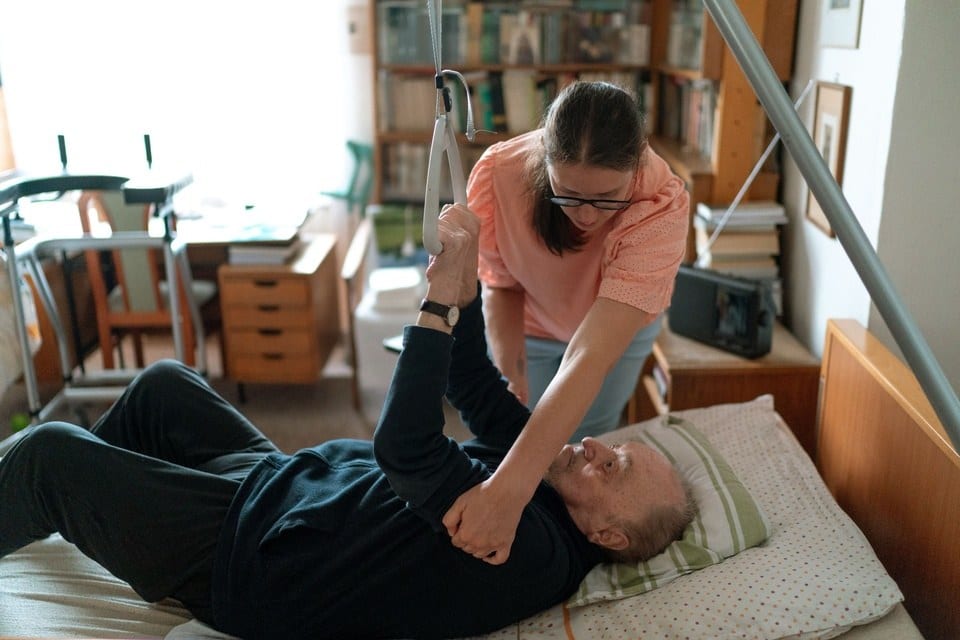
Does a scheduled inspection make the next transfer with a patient hoist safe? A National Patient Safety Alert from the UK Medicines and Healthcare products Regulatory Agency, issued on 16 September, describes continuing fatal and serious harm when people fall during transfers or repositioning. The agency’s accompanying release places the concern across hospitals, care homes and people’s own homes. It is not a recall of one manufacturer’s model.
The alert specifies checks before every use that can reveal missing parts, worn or damaged connectors, incorrectly seated sling loops and other deterioration. For loop attachments in particular, staff should pause once the sling is taut and partly supporting the person’s weight, before completing the lift, to confirm that every attachment is secure. Damaged or incorrectly assembled equipment should be taken out of service, marked accordingly and reported through the organisation’s route. This check addresses a risk at the point of use.
Choice of equipment is a separate part of the same transfer. The hoist and sling must be compatible according to the manufacturer’s instructions, with exceptional use of a third-party sling requiring qualified, documented verification. A recorded assessment should establish that the combination suits the individual. It needs repeating when the equipment changes or the person’s condition changes, including factors such as weight, posture, tone, cognition or ability to participate. Accessories also need to fit the hoist correctly.
Organisations are asked to maintain an equipment inventory, track servicing and train staff for the devices and settings in which they work. Under the UK’s LOLER rules, a competent person must carry out a thorough examination at intervals of no more than six months. Checks before use do not replace servicing or that statutory examination. Training should cover fitting, unsafe equipment states, stopping a transfer and reporting incidents and near misses.
The alert therefore treats safety as a sequence involving the patient, equipment and team. The six-month examination interval reflects UK law and should not be presented as a universal legal requirement. Both links are MHRA materials about the same alert, not independent studies of its effectiveness.
Cover: the patient-transfer image accompanying the MHRA release, GOV.UK, used under the Open Government Licence v3.0. Image source · Licence