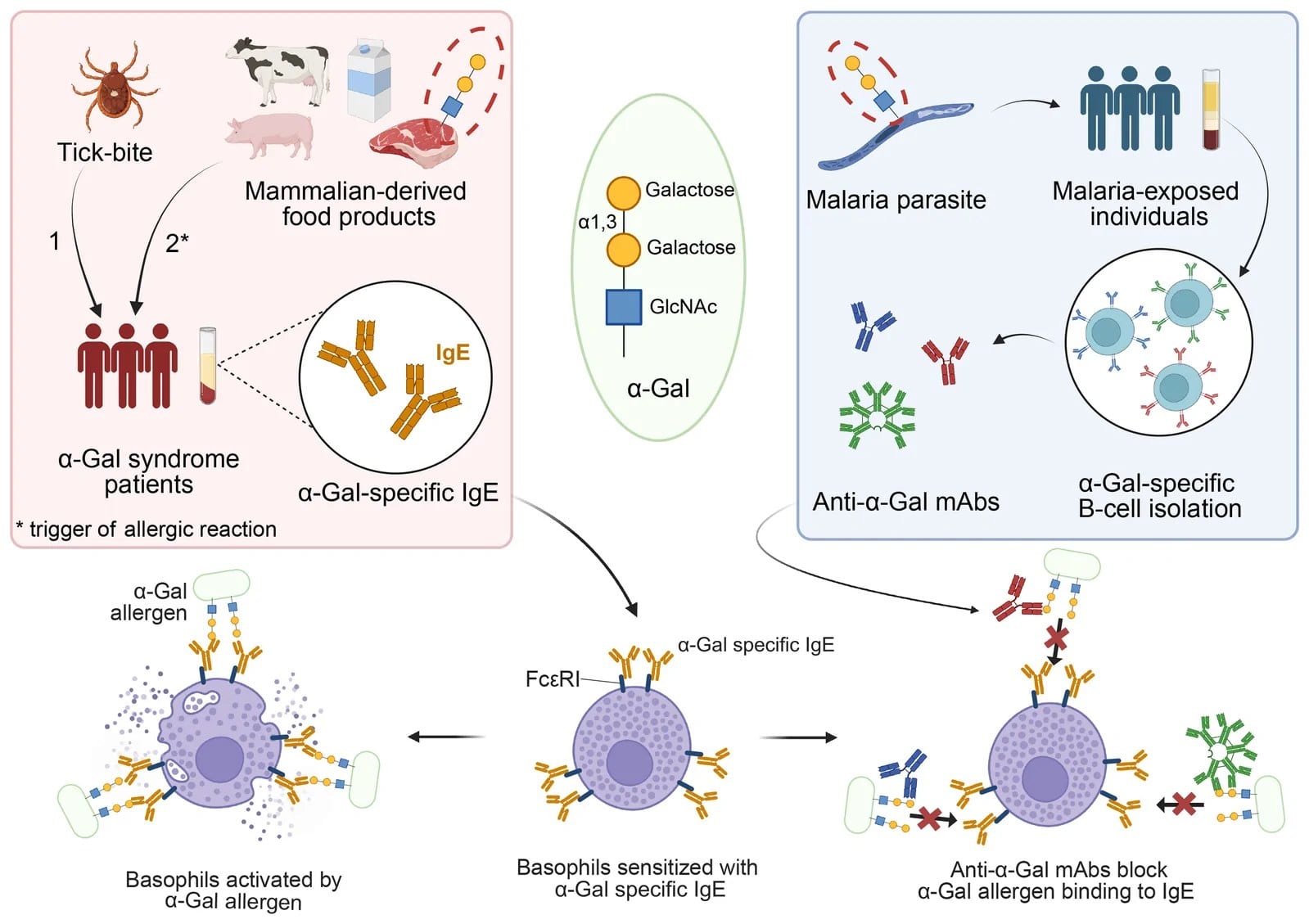
If an antibody binds alpha-Gal, can it also interrupt an allergic response in alpha-Gal syndrome? An open-access Journal of Clinical Investigation paper and the same paper’s PubMed record describe a screening sequence that separates those questions. They are two routes to one study, not independent confirmation.
The researchers initially sought antibodies recognising alpha-Gal on malaria parasites. From B cells donated by people with a history of malaria exposure, they isolated 42 human alpha-Gal-specific monoclonal antibodies, but found weak binding to the parasite tested. They then examined allergens relevant to alpha-Gal syndrome. Thirteen candidates bound the tested forms of angiotensin-converting enzyme, aminopeptidase N and cetuximab. These are counts of antibody candidates, not of patients treated.
Binding an allergen was only the first experimental threshold. In tests using serum from patients with alpha-Gal syndrome, AG028 in its IgA2 and IgM forms and AG050 in its IgA1 form blocked IgE binding to the tested angiotensin-converting enzyme and aminopeptidase N. The researchers then examined basophils sensitised with patient serum. AG028 in the two tested forms suppressed activation triggered by angiotensin-converting enzyme. The paper does not report the same cellular result for AG050.
The steps distinguish recognition of a sugar structure, competition with patient IgE and suppression of a laboratory cell response. The authors discuss how presentation of alpha-Gal on different carrier molecules may affect recognition. These findings provide a mechanistic basis for further development, but the study did not administer the antibodies as a treatment to people. It therefore cannot establish safety after dosing, how long any protection might last, or whether clinical allergic reactions would fall.
The authors disclosed a provisional US patent application concerning human anti-alpha-Gal antibodies. That interest does not, by itself, resolve or invalidate the laboratory results; it belongs in an assessment of the proposed clinical use. For now, AG028 and AG050 are research candidates. The reported experiments offer no basis for changing a patient’s diet or existing treatment.
Cover: the original graphical abstract, Cho et al., Journal of Clinical Investigation (2026), CC BY 4.0. It illustrates experimental mechanisms, not proven clinical efficacy. Image source · Licence