An antiviral’s role during acute infection does not establish whether it will improve symptoms that persist for months. Long COVID requires separate evaluation of treatment timing, duration and population. In its 29 September account of RECOVER-VITAL, NIH reported no significant benefit from extended nirmatrelvir–ritonavir treatment on the primary symptom outcomes.
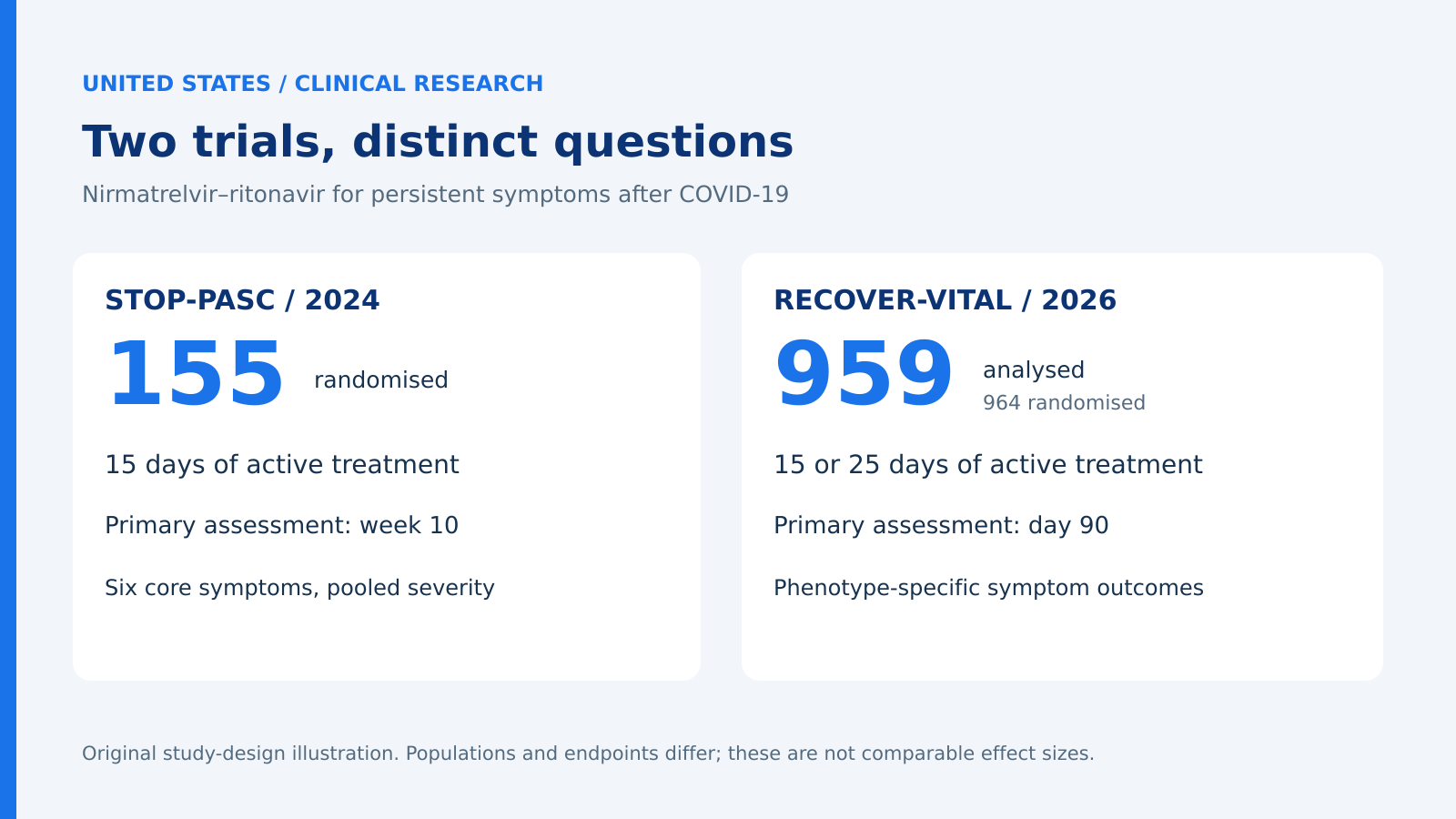
The published abstract describes a double-blind, randomised phase 2 trial at 69 US sites. Participants were adults with symptoms lasting at least 12 weeks. Of 964 people randomised, 959 entered the modified intention-to-treat analysis. The trial compared 15-day and 25-day active regimens with a placebo–ritonavir control, assessing cognitive, autonomic and exercise-intolerance phenotypes at day 90.
This larger study adds to an earlier investigation. The STOP-PASC trial, published in 2024, enrolled 155 participants at Stanford, almost all vaccinated. A 15-day regimen did not significantly improve the pooled severity of six core symptoms at week 10. RECOVER-VITAL expanded the number of sites and participants and included a 25-day active-treatment group, without finding a significant benefit on its primary outcomes.
The findings point in a similar direction, but their populations, symptom measures and assessment times differ. They cannot simply be combined into a single treatment-effect estimate. The NIH account and RECOVER-VITAL paper are also two presentations of one study, not independent confirmations.
A remaining research question is whether differing mechanisms might be associated with different responses. NIH describes further biomarker analysis as planned work. That does not establish an effective subgroup in advance. Future findings would need scrutiny of prespecification, sample size and support from other research.
For now, the conclusion applies to the populations, regimens and primary outcomes actually studied. The trials do not support routine extension of treatment for long COVID, but neither do they settle every antiviral strategy or disease subtype. A negative result remains useful when it defines the limits of one approach and makes the next question more precise.
Our RECOVER-VITAL review covers its public abstract and NIH account. Pfizer funded STOP-PASC and participated in design, execution and manuscript review. The cover distinguishes randomised and analysed populations, not treatment-effect sizes.
References