Registration trials establish whether a treatment can work under a defined protocol. Routine care asks a related but different question: what treatment do patients actually receive across hospitals, and what outcomes are recorded when dose, duration and patient characteristics vary? The BRAVE study, published on 30 September, offers prospective evidence from 32 centres in China on brentuximab vedotin-based treatment for adults with CD30-positive lymphoma.
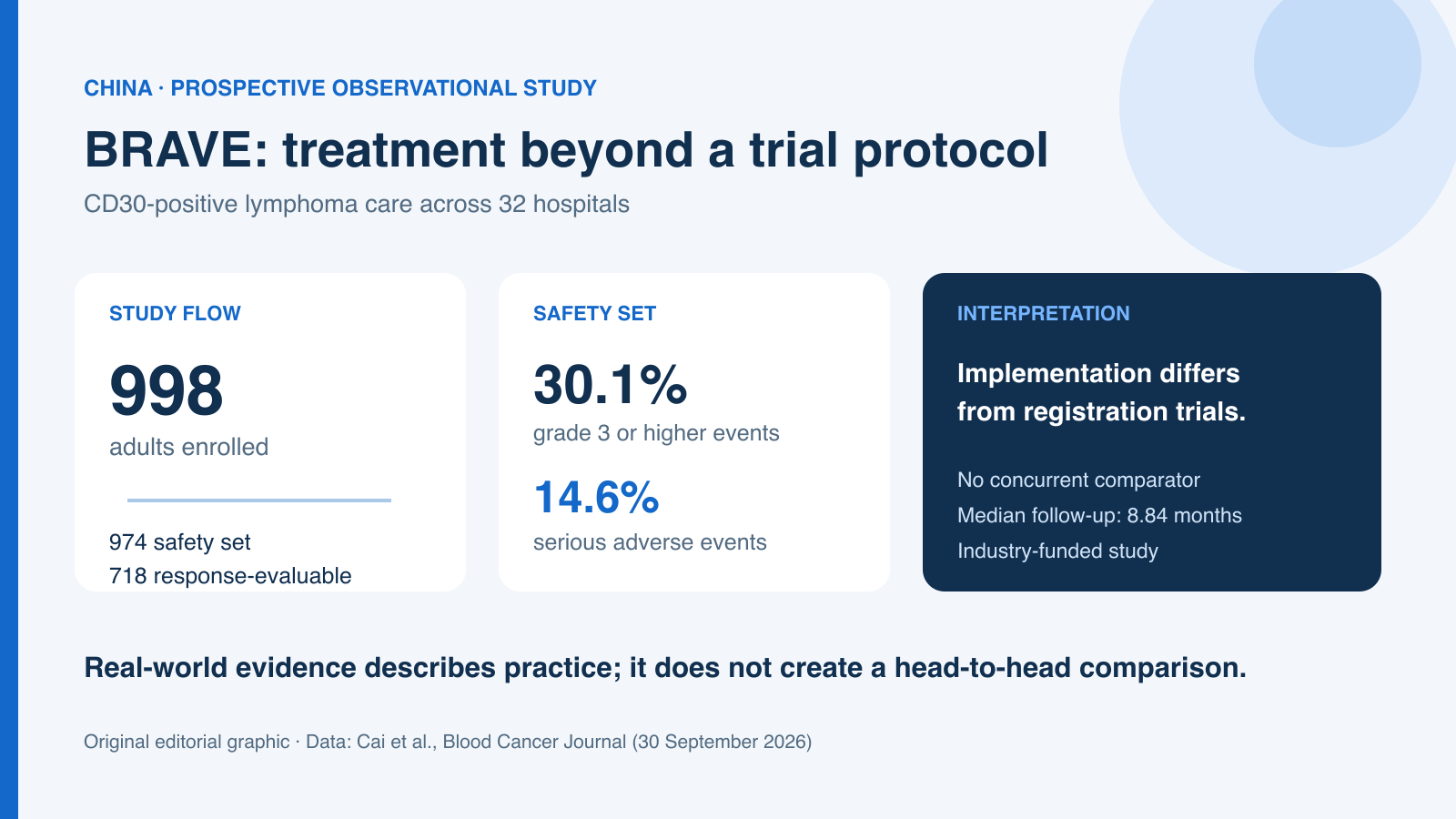
The observational study enrolled 998 adults between June 2021 and June 2024. Of these, 974 received at least one dose and entered the safety set; 718 had evaluable post-baseline response data. Median follow-up was 8.84 months. The cohort included classical Hodgkin lymphoma, peripheral T-cell lymphoma and B-cell lymphoma, across newly diagnosed and relapsed or refractory disease.
Delivery in practice did not reproduce every feature of the ECHELON registration trials used by the authors as predefined benchmarks. Patients received a median of five brentuximab vedotin cycles overall. Median dose intensity in the three ECHELON-aligned subgroups was below the corresponding protocol level, and people aged 60 or over received fewer cycles than younger participants. These findings describe implementation; they do not show why treatment was reduced or establish the effect of doing so.
In the safety set, 70.3% experienced an adverse event of any grade, 30.1% experienced a grade 3 or higher event, and 14.6% had a serious adverse event. Infection was the most common serious event category, affecting 5.2%. The investigators recorded drug-related adverse reactions leading to death in six patients with peripheral T-cell lymphoma, five of whom were older adults; the deaths were attributed to infection. Without a concurrent comparison group, these figures cannot estimate a relative risk against another regimen.
Among the 718 response-evaluable patients, the overall objective response rate was 75.3%. In cohorts aligned with the ECHELON studies, objective response rates were broadly comparable with the registration trials, while complete response rates were consistently lower. That is an indirect cross-study comparison, not evidence of equivalence or non-inferiority. Differences in lymphoma subtype, treatment exposure and response assessment may all contribute.
Several limits matter before applying the results. CD30 expression was assessed locally without central review, response assessment was not protocolised, and some participants lacked evaluable post-baseline data. The short follow-up also limits conclusions about durability and survival. Takeda China funded the study and the reported medical-writing support. BRAVE therefore adds useful evidence about how treatment is delivered in Chinese practice, but it does not replace randomised comparisons or individual clinical judgement.
The cover is an original editorial graphic based on the reported study flow and safety results; it does not reproduce a journal figure.
References